In the world of chiropractic care, the pursuit of spinal health isn’t just about “cracking backs”—it’s about restoring the body’s natural ability to move. One of the most distinctive and effective tools in a modern chiropractor’s arsenal for achieving this is the Y-Strap adjustment.
While it might look intense on social media, the Y-Strap (or Y-Axis Traction Strap) is a specialized decompression tool designed to address spinal compression and restricted range of motion with precision.
What is the Y-Strap Adjustment?
The Y-Strap is a chiropractic tool used to perform long-axis manual traction. The name comes from the “Y-axis” of the body—the vertical line running from your head to your feet.
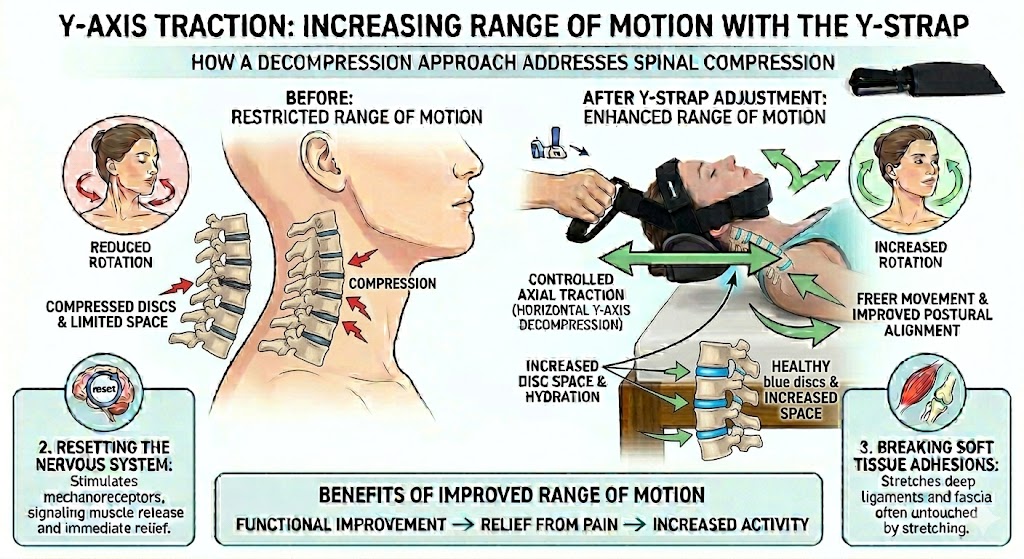
Unlike traditional “rotational” adjustments, where a chiropractor applies a quick thrust to a specific vertebrae by twisting or pushing, the Y-Strap focuses on decompression. The chiropractor secures the strap around the base of the patient’s skull and applies a controlled, steady pull (or a high-velocity, low-amplitude tug) away from the torso.
How It Increases Range of Motion
Restricted movement often stems from “joint fixation” or compressed intervertebral discs. Here is how the Y-Strap breaks through those barriers:
1. Decompressing the Spinal Column
Daily life—gravity, poor posture, and heavy lifting—constantly compresses our spines. This pressure can “squish” the discs between vertebrae, leading to stiffness. By pulling along the Y-axis, the strap creates space between the vertebrae, allowing the discs to rehydrate and the joints to move more freely.
2. Resetting the Nervous System
When a joint is stuck, the surrounding muscles often go into a protective spasm, further limiting your movement. The quick stretch provided by a Y-Strap adjustment stimulates mechanoreceptors in the spine. This sends a signal to the brain to “reset” muscle tone, often resulting in an immediate decrease in tension and an increase in flexibility.
3. Breaking Soft Tissue Adhesions
Chronic stiffness is often caused by “stuck” connective tissues. The linear force of the Y-Strap helps stretch the deep ligaments and fascia that surround the cervical and thoracic spine, areas that are notoriously difficult to mobilize through stretching alone.
Benefits Beyond the “Crack”
While the audible “pop” (cavitation) is a hallmark of the treatment, the true goal is functional improvement. Patients who undergo Y-Strap adjustments often report:
-
Improved Rotation: Easier time turning the head while driving or looking over the shoulder.
-
Postural Alignment: A feeling of standing “taller” as the slouching caused by compression is alleviated.
-
Reduced Nerve Interference: Relief from tingling or numbness in the arms caused by compressed cervical nerves.
Is it Right for Everyone?
Because the Y-Strap involves a firm pull on the cervical spine, it is not a “one-size-fits-all” solution. A professional chiropractor will always perform a physical exam and potentially take X-rays before using the device. It is generally avoided for patients with:
-
Severe osteoporosis
-
Certain cardiovascular issues (like carotid artery stenosis)
-
Acute spinal fractures or unstable disc herniations
Conclusion
The Y-Strap is more than just a viral sensation; it is a powerful biomechanical tool. By addressing spinal health through the lens of decompression, it provides a unique pathway to restoring range of motion. If you feel like you’re “carrying the weight of the world” on your neck and shoulders, this vertical approach to alignment might be exactly what your body needs to move freely again.
Author: Marco Abanico
If you would like to seek chiropractic care with Dr Marco Abanico, please call/text us at 513-580-4930.